Related Books
Filter by Era
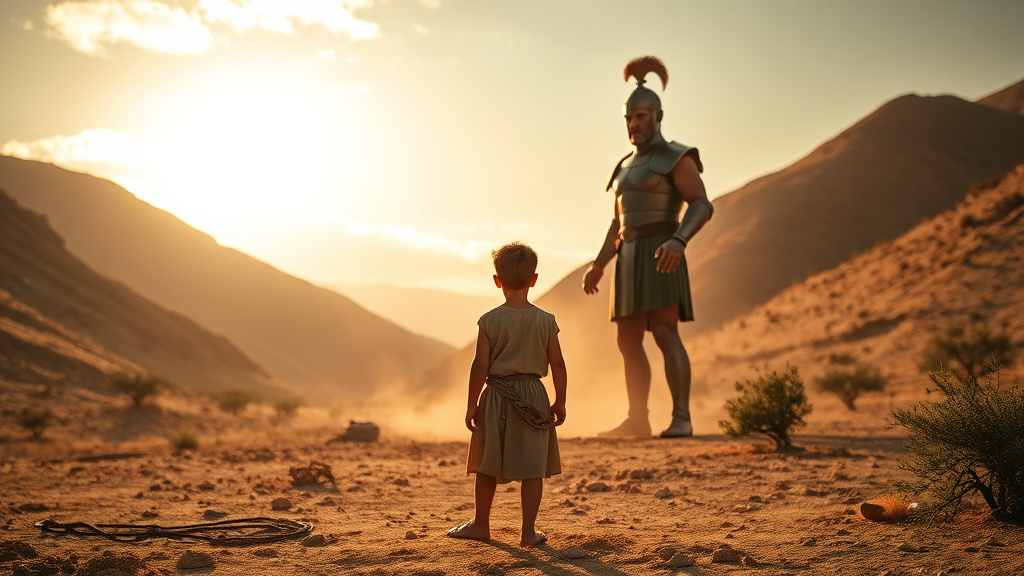
1samuel 17
1samuel · Ch.17
Stone Against the Champion
1 Samuel 7:12
judaism「Samuel took a stone and set it up between Mizpah and Shen, and named it Eben-ezer: “For up to now,” he said, “GOD has helped us.”」
How does the Catholic tradition understand David vs. Goliath as a model of faith?
Drawing on patristic exegesis and tradition as a type of spiritual warfare.
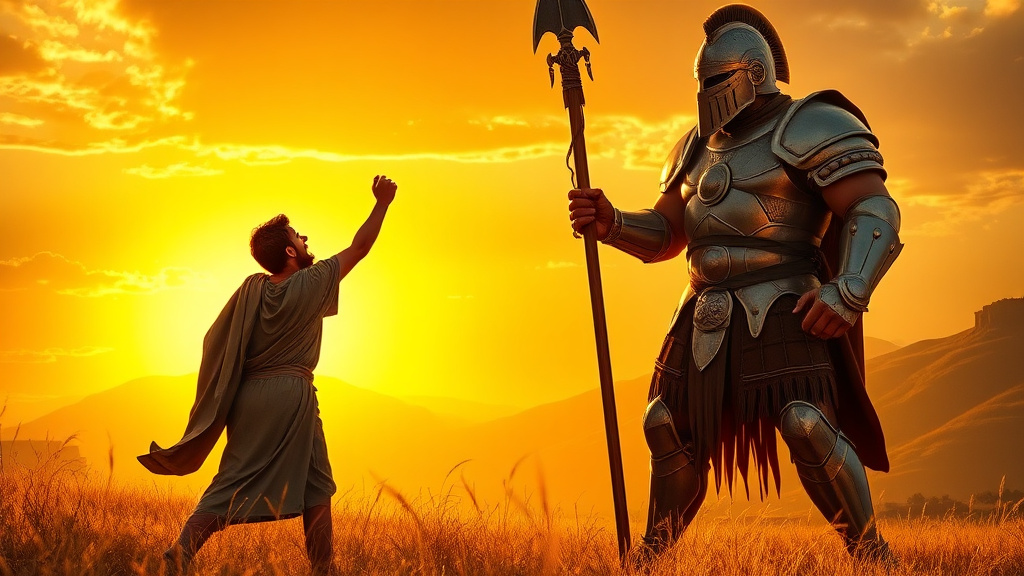
1samuel 17
1samuel · Ch.17
David vs Goliath: A Battle of Faith
1 Samuel 25:4
protestant「And David heard in the wilderness that Nabal was shearing his sheep.」
Why does the Philistine champion propose single combat to decide the fate of two armies?
Ancient Near Eastern customs of champion warfare—what cultural and theological assumptions underlie this proposal?
1 Samuel 31:6
judaism「Thus Saul and his three sons and his arms-bearer, as well as all his men, died together on that day.」
Did Goliath boast in military might or in his gods, and how does this clash with Israel's monotheism?
The Philistine threat was not only spears but the arrogance of idolatry itself.
1 Samuel 20:4
judaism「Jonathan said to David, “Whatever you want, I will do it for you.”」
How does Catholic tradition see David's victory over Goliath as a type of Christ?
Typological reading of the shepherd boy's triumph over the giant.
1 Samuel 26:13
judaism「David crossed over to the other side and stood afar on top of a hill; there was considerable distance between them.」
What is the symbolic significance of Goliath's armor versus David's chosen weapon?
Heavy armor and a sword versus five smooth stones — who is truly mighty?
1 Samuel 9:7
judaism「“But if we go,” Saul said to his servant, “what can we bring the man? For the food in our bags is all gone, and there is nothing we can bring to the agent of God as a present. What have we got?”」
In 1 Samuel 17:45-47, David declares to Goliath, 'You come against me with sword and spear... but I come against you in the name of the LORD Almighty.' How does David's theological framing of the battle shape our understanding of spiritual warfare?
How David's words frame the nature of true conflict.
1 Samuel 8:2
protestant「Now the name of his first-born was Joel; and the name of his second, Abijah: they were judges in Beer-sheba.」
What gave David the confidence to refuse Saul's armor before facing Goliath?
A shepherd boy rejecting royal armor — reckless faith or deeper wisdom?
1 Samuel 16:11
judaism「Then Samuel asked Jesse, “Are these all the boys you have?” He replied, “There is still the youngest; he is tending the flock.” And Samuel said to Jesse, “Send someone to bring him, for we will not sit down to eat until he gets here.”」
After David kills Goliath, how do the women of Israel celebrate, and what is the significance of this scene?
Songs over Goliath's fall launch a shepherd onto the stage of history.
1 Samuel 24:2
protestant「Then Saul took three thousand chosen men out of all Israel, and went to seek David and his men upon the rocks of the wild goats.」
David's question, 'Who is this uncircumcised Philistine that he should defy the armies of the living God?' (1 Samuel 17:26) frames the battle as a theological issue, not merely a military one. How does this framing change the way we read the rest of the chapter?
A theological reading of David's confrontation with Goliath.
1 Samuel 8:3
judaism「But his sons did not follow in his ways; they were bent on gain, they accepted bribes, and they subverted justice.」
In 1 Samuel 17:34–37, David recounts his past as a shepherd defending his flock from lions and bears. How does this background shape his confidence when facing Goliath, and what does it reveal about how God prepares people for unexpected challenges?
Explore how David's pastoral background becomes the unlikely training ground for Israel's greatest military moment.
1 Samuel 29:7
judaism「So go back in peace, and do nothing to displease the Philistine lords.”」
What is the deeper meaning of David's famous declaration to Goliath?
'You come against me with sword and spear'—how should this declaration be understood?
1 Samuel 14:19
judaism「But while Saul was speaking to the priest, the confusion in the Philistine camp kept increasing; and Saul said to the priest, “Withdraw your hand.”」
How does Saul's jealousy reveal a spiritual crisis after David's victory over Goliath?
After the victory, the real battle is just beginning.
1 Samuel 20:17
protestant「And Jonathan caused David to swear again, for the love that he had to him; for he loved him as he loved his own soul.」
How does the Talmud comment on David's refusal to wear Saul's armor?
What does the Rabbinic tradition say about David's light equipment as trust in God?
1 Samuel 15:3
judaism「Now go, attack Amalek, and proscribe all that belongs to him. Spare no one, but kill alike men and women, infants and sucklings, oxen and sheep, camels and donkeys!”」
Why did David select five smooth stones, and is there significance to the number?
Did the five stones hint at Goliath's brothers, or reflect David's prudent preparation?
1 Samuel 5:1
protestant「Now the Philistines had taken the ark of God, and they brought it from Eben-ezer unto Ashdod.」
Why did David choose a sling and stones instead of Saul's armor when facing the giant?
From shepherd to warrior—what does David's seemingly illogical choice reveal about faith and courage?
1 Samuel 1:15
protestant「And Hannah answered and said, No, my lord, I am a woman of a sorrowful spirit: I have drunk neither wine nor strong drink, but I poured out my soul before Jehovah.」
Why did David refuse Saul's armor and choose a sling and stones instead?
Rejecting human armor to rely fully on God's power.
1 Samuel 2:6
judaism「GOD deals death and gives life,Casts down into Sheol and raises up.」
In 1 Samuel 17:45, David responds to Goliath with 'You come against me with sword and spear and javelin, but I come against you in the name of the LORD of hosts.' What does this contrast reveal about the nature of true spiritual authority?
Examine how David's reliance on God's name redefines victory and authority in the face of overwhelming odds.
1 Samuel 6:12
protestant「And the kine took the straight way by the way to Beth-shemesh; they went along the highway, lowing as they went, and turned not aside to the right hand or to the left; and the lords of the Philistines went after them unto the border of Beth-shemesh.」
Where did David's confidence truly come from before facing Goliath?
What gave a young shepherd the courage to challenge a seasoned warrior giant?
1 Samuel 11:14
judaism「Samuel said to the people, “Come, let us go to Gilgal and there inaugurate the monarchy.”」
What does David's refusal of Saul's armor teach us about spiritual battles today?
Can stepping out in weakness be more powerful than wearing borrowed strength?
1 Samuel 4:7
judaism「the Philistines were frightened; for they said, “God has come to the camp.” And they cried, “Woe to us! Nothing like this has ever happened before.」
How do David's words before facing Goliath demonstrate his trust in God?
"I come against you in the name of the Lord of hosts"—how deep is the spiritual meaning of this declaration?
1 Samuel 21:1
judaism「David then went his way, and Jonathan returned to the town.」
David declares to Goliath in 1 Samuel 17:45-47, 'You come against me with sword and spear, but I come against you in the name of the Lord.' How should Christians understand the contrast between conventional weapons and spiritual authority?
Spiritual warfare themes in David's confrontation.
1 Samuel 26:2
protestant「Then Saul arose, and went down to the wilderness of Ziph, having three thousand chosen men of Israel with him, to seek David in the wilderness of Ziph.」
What does David's confident declaration 'You come against me with sword and spear and javelin, but I come against you in the name of the Lord of hosts' (1 Samuel 17:45) reveal about his understanding of who truly wins battles? How does this perspective challenge modern approaches to conflict?
Explore the theological heart of David's victory speech and what it means to fight 'in God's name' rather than by conventional means of power.
1 Samuel 23:18
protestant「And they two made a covenant before Jehovah: and David abode in the wood, and Jonathan went to his house.」
Why does Saul appear so passive and fearful while David steps forward to face Goliath?
A contrast of two leaders: Saul's silence versus David's initiative—what spiritual realities does this expose?
1 Samuel 2:9
protestant「He will keep the feet of his holy ones; But the wicked shall be put to silence in darkness; For by strength shall no man prevail.」
Why did David choose five smooth stones from the stream?
Five stones when one was needed—was there a hidden meaning?