Genesis 8:18
protestant「And Noah went forth, and his sons, and his wife, and his sons' wives with him:」
Genesis 30:40
protestant「And Jacob separated the lambs, and set the faces of the flocks toward the ringstreaked and all the black in the flock of Laban: and he put his own droves apart, and put them not unto Laban's flock.」
Genesis 27:11
protestant「And Jacob said to Rebekah his mother, Behold, Esau my brother is a hairy man, and I am a smooth man.」
Genesis 5:31
protestant「And all the days of Lamech were seven hundred seventy and seven years: and he died.」
Genesis 2:3
protestant「And God blessed the seventh day, and hallowed it; because that in it he rested from all his work which God had created and made.」
Genesis 4:1
protestant「And the man knew Eve his wife; and she conceived, and bare Cain, and said, I have gotten a man with the help of Jehovah.」
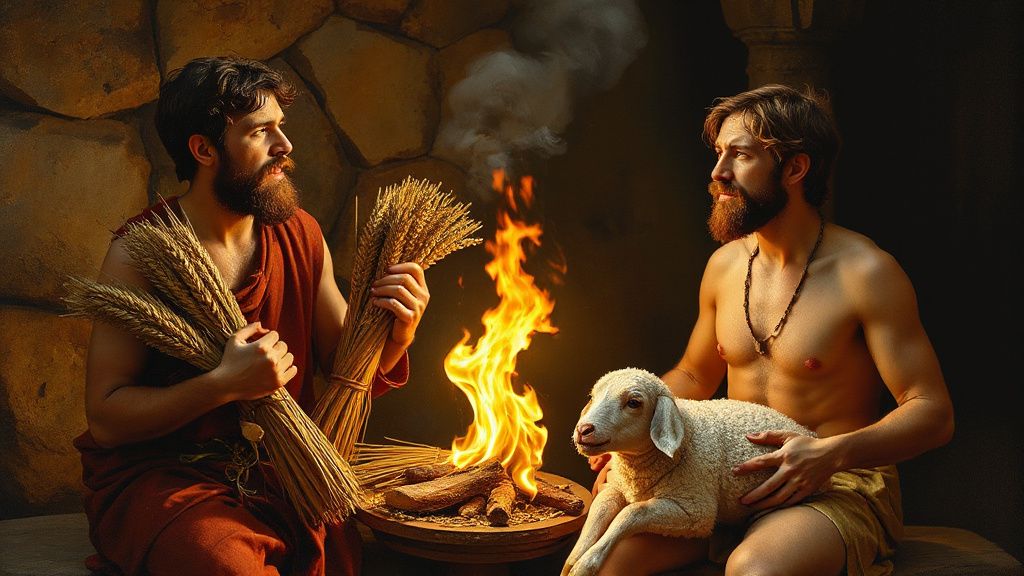
Offering
allCain brought fruit of the ground while Abel offered the firstlings and fat. This early account foreshadows the sacrificial system, showing that acceptable worship requires faith and a worthy offering.
Babel
allMeaning 'confusion,' named because Jehovah confounded human language there. Symbolizes human pride and divine judgment upon collective rebellion.
Offering
allA gift or sacrifice presented to God. Cain offered produce of the ground while Abel offered firstlings of his flock, illustrating that acceptable worship requires a proper heart and faith.
Voice of Blood
allAbel's blood crying from the ground establishes the biblical motif that innocent blood cries out for justice (cf. Heb 12:24), anticipating the atoning and interceding blood of Christ.
Voice of the Blood
allAbel's blood crying out to God from the ground, signifying that innocent blood pleads for divine justice, foundational to the biblical theology of blood vengeance and atonement.
Dispersion
allThe divine scattering of nations at Babel, reversing humanity's attempt to remain unified and make a name for itself apart from God.
How does being made in the image of God define human dignity?
Genesis 1:26 lays the foundation for a shared view of humanity across Judaism, Catholicism, and Protestantism.
When God said 'Let there be light' on the first day, in what kind of 'darkness' was He speaking before light existed?
The coexistence of light and darkness in Genesis 1 sparks reflection on the state before God acted.
What does being created 'in the image of God' specifically mean?
Exploring the theological significance of human uniqueness in Genesis
What is the significance of the name 'Yahweh Yireh' for Abraham and for later generations?
By naming the place, what provision and foresight of God did Abraham proclaim?
How does rabbinic tradition interpret the Sabbath rest of Day 7 as the completion of the seven days of creation?
The Sabbath as the crown of creation and a covenant of rest with the made world.
Does the 'after its kind' principle (Gen 1:24) imply creation was bounded and ordered?
Does God's classification of creatures limit the possibilities of evolution and biological boundaries?
🎬 Courseprotestant
Genesis 1:1-5
Genesis · Ch.1
Genesis 1:1-5 First Five Days
V 02min
Creation and PatriarchsBabel/Ur
🎬 Courseprotestant
Genesis 1:6-25
Genesis · Ch.1
Genesis 1:6-25 The Sixth Day
V 102min
Creation and PatriarchsBabel/Ur